
When people discuss the housing crisis today, they typically focus on the supply side of the issue.
“How many homes are being built. How much are prices rising?”
However, hidden in between this debate is one piece that rarely makes the headlines: supported living.
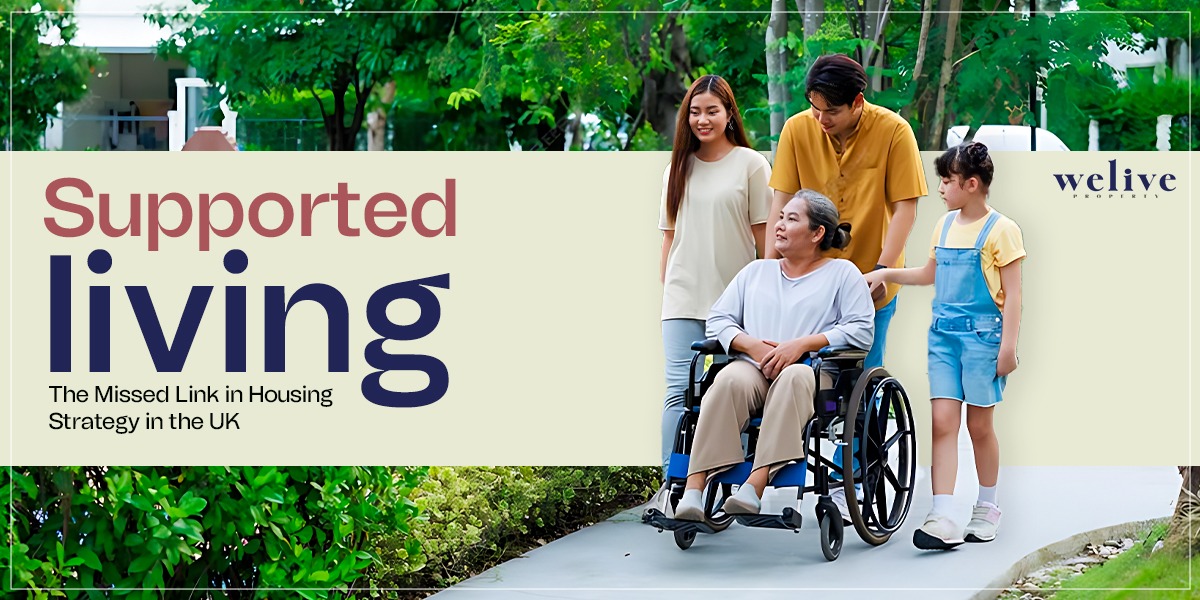
Supported living is not just about roofs and walls. It is about providing safe, affordable homes with the right level of care and support. So that people can live independently, recover with dignity, and remain active members of their communities.
The year is 2025. There is a growing body of evidence that is advancing the idea that the key that is missing in the UK housing policy is supported living. The lack of it results in straining the NHS, underserving the ageing population of the UK, and thousands of vulnerable individuals put in jeopardy at the moment of writing.
NHS Discharges- A Straining System
A roundtable on the issue of the delay in hospital discharge was conducted recently by the Royal College of Psychiatrists and the National Housing Federation (NHF). The findings were stark:
- In 2023/2024, 18 percent of total delayed hospital discharges were caused by patients who waited to receive supported living.
- That amounts to 109,029 days of mental hospital delayed discharge. All placing a 71m GBP burden on the NHS in one year.
- The study found out that the saving of between £ 53 million to 65 million a year by the NHS was as a result of the reduction of delayed discharges.
Behind the numbers are people who are clinically ready to leave the hospital, but have nowhere suitable to go. Some need supported housing placements before they can actually live independently again. Other individuals need step-down units, so as to prevent readmission.
The roundtable has made one thing abundantly clear: Supported living is not just a housing policy. It is healthcare.
A Sector In Crisis
At the very moment, when demand is rising, supply is shrinking. More than 150 organizations, including Age UK, the Royal British Legion, Refuge, and the Local Government Association, recently wrote to the Prime Minister, warning that the supported housing sector is in a financial crisis.
Over 70,000 supported homes are at risk of closure. A third of providers (32 percent) reported closing schemes last year due to finding measures. Moreover, since 2010, nearly 2 in 5 supported accommodation services for single homeless people have shut their doors. This means that the cause is clear. Funding cuts, Inflation, Higher Energy Costs, and New Regulatory Obligations have squeezed margins. Council contracts have been eroded by over 75 percent in the past decade.
Kate Henderson, Chief Executive of the NHF, has put it: “Without urgent action from government, there is a real risk that we lose tens of thousands of homes. All founded on the mission to give people with support a solid foundation.”
The Ageing Population Challenge.
Demographics, too, are shifting fast. The number of people aged 65 plus is forecast to rise from 11.7 million to 14.3 million by the end of 2025. A 22 percent increase. By 2050, one in four people in the UK will be over 65. Yet, only 0.6% of them living in housing with care, compared to 5 percent in the USA and Australia.
Intrinsically, high-quality and affordable, well-located choices are short in terms of their chronic scarcity. The UK requires 30,000 to 50,000 homes in the later-living category annually. By now, we are already delivering less than 7,000.
The notion of supported living of older adults is not merely concerned with the quality of life and dignity. It is also concerned with shortening hospital stays, decreasing NHS waiting lists, and enabling individuals to age in their own placess with proper safety.
What a National Strategy Needs
Experts from the University of York have argued that supported living must be embedded in local authority planning, with straightforward evidence-based commissioning. National organizations are calling for atleast 1.6 billion GBP annually ring-fenced for supported housing contracts. They are also calling for a stronger capital funding pipeline, including the reinstatement of the 300 million GBP Housing Transformation Fund.
In short, supported living needs to be treated as essential infrastructure, with long-term revenue funding made available to ensure hospital discharge schemes are sustainable.
WeLive’s Role
At WeLive, we believe accommodation for supported living is not optional. It is urgent. Our model is simple but powerful.
- We convert underutilized properties into high-quality co-living HMOs
- We deliver premium ensuite rooms, built with comfort, safety, and dignity in mind.
- We manage the full lifecycle. From acquisition to planning, maintenance, and care partnerships. All in-house.
And most importantly, we work closely with London Boroughs, the NHS and registered care providers to ensure our homes serve community needs.
Final Thoughts
Supported Living is the missing link in the UK’s housing strategy. It is not just about supply. It is about health. Ageing with dignity. About preventing homelessness and about relieving the NHS.
The numbers are clear. Without Supported Living, people stay in hospitals too long, costs spiral and communities suffer. With it, people recover faster, live better and public services save billion.
At WeLive, we believe the future of housing is not just more homes. It is the right kind of homes. Homes that support, connect and empower people to thrive.
And that is the future we are working to build in London.
