
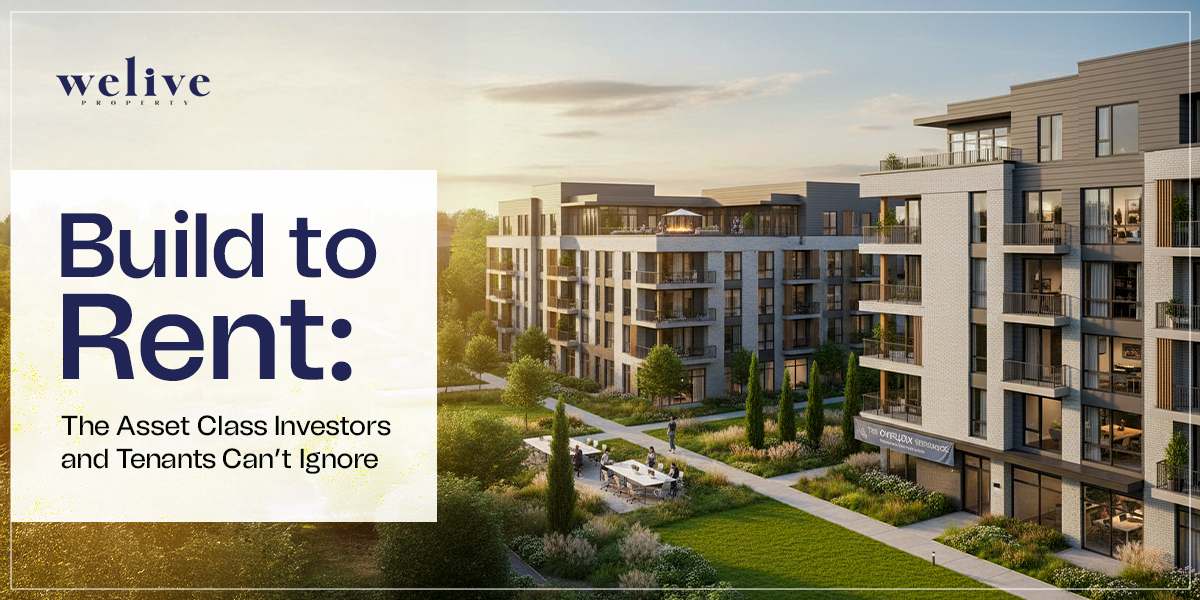
Build-to-Rent (BTR) has quietly become one of the most resilient sectors of the UK housing market. It is seen today as a long-term income-generating asset class. Less volatile than sales-led housebuilding and more predictable than short-let models. This positive outlook towards BTR is also reflected in the numbers. According to Knight Frank’s Market Update Q2, in the first half of 2025 alone, more than 2.2 billion GBP was invested into BTR schemes across the UK. And it is not just investors who are taking notes. Tenants, too, are moving in just as quickly – with the median time to let a BTR home in Q2 of 2025 being just 17 days. This data, rather than merely indicating the increase in BTR letting time, also reveals significant insights into what renters desire today.
Instead of “Where WeLive Fits”, how about – WeLive’s Role in the BTR Revolution
To those who are aware and to those who are not, know that the broader housing market is under strain. The August 2025 RICS Residential Market Survey shows that new buyer enquiries fell for the second consecutive month. A net balance of -17 percent. During that time period, agreed sales also dropped to a measly 24 percent. Elsewhere, house prices also slipped, with a net balance of -19%.
However, in a sharp contrast, tenant demand continued to remain positive. This, despite landlord instructions dropping to -37 percent, the weakest since April 2020. The imbalance is clear to see: fewer homes for rent, more people chasing them.
Against such a backdrop, Build-to-Rent stands as an anomaly. Therefore, momentum matters because it signals a structural shift. If sales remain subdued and traditional landlords continue to exit the market, renters will increasingly turn to Build-to-Rent schemes. Naturally, for investors, this shift creates an asset class (BTR) that is counter-cyclical. One that grows when both buying and traditional rental options are constrained. Plus, for councils and policymakers, the growth of BTR helps plug the gap. This will ensure supply does not collapse just as demand rises.
Where WeLive Fits
Incidentally, at WeLive Property, this shift towards BTR is precisely where our mission sits. Our focus on Build-to-Rent co-living housing comes from the belief that housing must evolve to match the way people live. That means, supported, community-led homes that balance affordability, quality, and service.
Our process covers the entire lifecycle:
- Construction Management Plans, Ecology Reports, And Contaminated Land Assessments
- Design Access Statements and Planning Applications
- Site Visits, Negotiations, and Final Handover
Every step is managed in-house, giving property owners, investors, and councils confidence that projects will not only be delivered but also done so with precision, compliance, and care.
Case Study: Brighton Road, Sutton
A perfect example of our work is the project at Brighton Road in Sutton. What began as a 3-bedroom detached house is now a 10-ensuite co-living HMO.
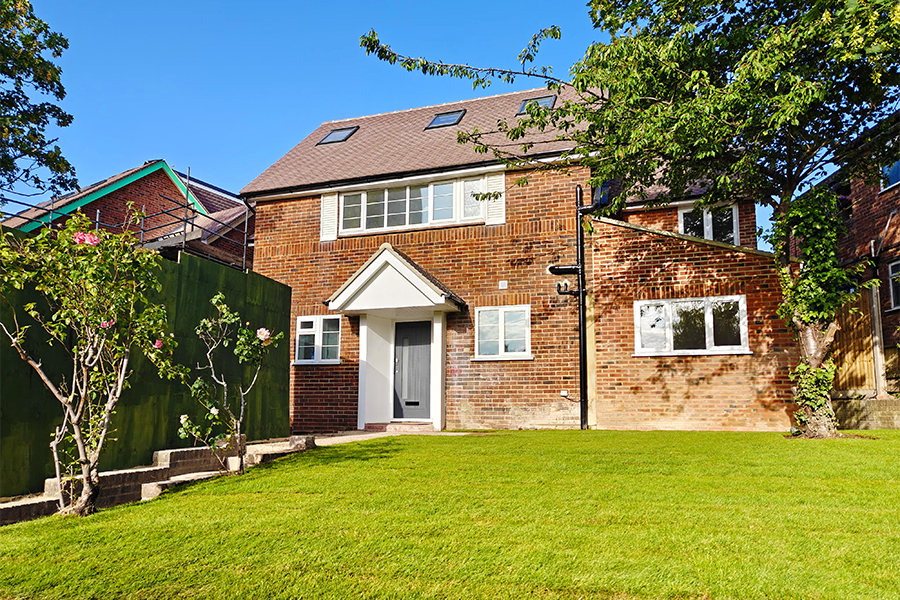
And we managed the entire process. Securing phased approvals via permitted development, CLEUD, and change of use. Gained permissions for double-storey extensions and loft conversions, then optimised layout for space, natural light, and most importantly, rental potential.
The result today is a high-quality, community-first living space, just five minutes from Sutton Station. This project, dear readers, is Build-to-Rent in action: transforming dilapidated, underutilized, and unlivable properties into supported living spaces tailored to today’s needs.
Non-negotiability in ESG
Environment, Social, and Governance. While capital and speed tell one side of the story, ESG covers the other three aspects:
- Environmental: How energy-efficient and sustainable a building is, from insulation and heating system to carbon footprint
- Social: How housing supports communities, affordability, and well-being
- Governance: How responsibly a project is being managed, beginning from compliance with regulations to transparency with investors and local authorities.
Why does this matter? Because ESD is no longer a “nice-to-have” acronym. It directly shapes investment flows, regulation, and tenant affordability in 2025. Net Zero 2050 targets are reshaping the delivery of housing. Whole-life carbon assessments are now a core part of development evaluations (for more details, refer to CBRE’s UK Real Estate Market Outlook 2025). In the meantime, the UK Green Building Council is emphasizing that four in five homes that will be occupied in 2050 have already been built. This fact means retrofitting is unavailable (UKGBC, Home Retrofit Guide)
And this is not just an environmental issue. With energy bills still being one of the most significant pressures on households, sustainability becomes an affordability strategy. What this means is that with better-insulated homes and more efficient systems, operating costs for tenants reduce, making housing greener and fairer. Additionally, as regulations tighten, energy-efficient stock is likely to attract premium demand from investors.
Co-living designs by WeLive naturally reduce per capita energy use. Shared heating, water systems, and optimized layouts reduce both costs and carbon emissions. As a result, we deliver homes that are not only financially viable but also environmentally responsible. Plus, not to mention, being aligned with the cost-of-living realities faced by tenants in 2025.
Planning Still Decides the Pace of BTR
Even with capital flowing and tenant demand strong, one hurdle remains: Planning.
The UK Government acknowledges that planning delays cost councils an estimated 250,000 hours annually in manual document handling—source: UK Government, Extract AI Planning Tool Announcement (2025). Until digitisation scales, approvals will continue to slow down delivery.
That is why developers who prepare well stand out. At WeLive, our in-house team handles Construction Logistics Plans, Design Access Statements, and Ecology Reports as standard. By frontloading compliance, we reduce risk for councils and speed approvals.
For property owners, that means unlocking the hidden value sooner. For investors, it means faster returns. For tenants, it means moving into safe, modern homes without unnecessary delays.
Communities: More Than Housing Units.
According to RICS, the buyers have moved back and renters are experiencing more competition. There is a limited number of homes that families, students, NHS staff, and older adults are all competing for. Supported living is increasingly becoming the only viable option for others.
And here is how WeLive has its motto: Accommodation For Supported Living. All WeLive projects are community-oriented. Our homes are not only compliance units, but we also collaborate with the London Boroughs, the NHS, and registered care providers. Whether it is flooring selection or property management, it is all about establishing safe, interconnected, and dignified living environments.
Conclusion: What Build-to-Rent ACTUALLY Mean to You?
The future of housing in 2025 is not necessarily about increasing the number of homes. Build-to-Rent has ceased to be a niche. Investors are backing it. Tenants are demanding it. Councils are recognising it.
At WeLive, our role is clear. From Initial Consultations and Site Assessments to Strategic Planning, Visualisations, and Final Handover, we manage every stage of the property lifecycle.
All the surveys, all the plans, all the negotiations are connected with one mission, which is to provide Accommodation to Supported Living.
Since housing is not merely about property. It’s about people.
