

The Next Generation of UK New Towns 2025: What England’s Housing Development Push Means for Developers and Investors
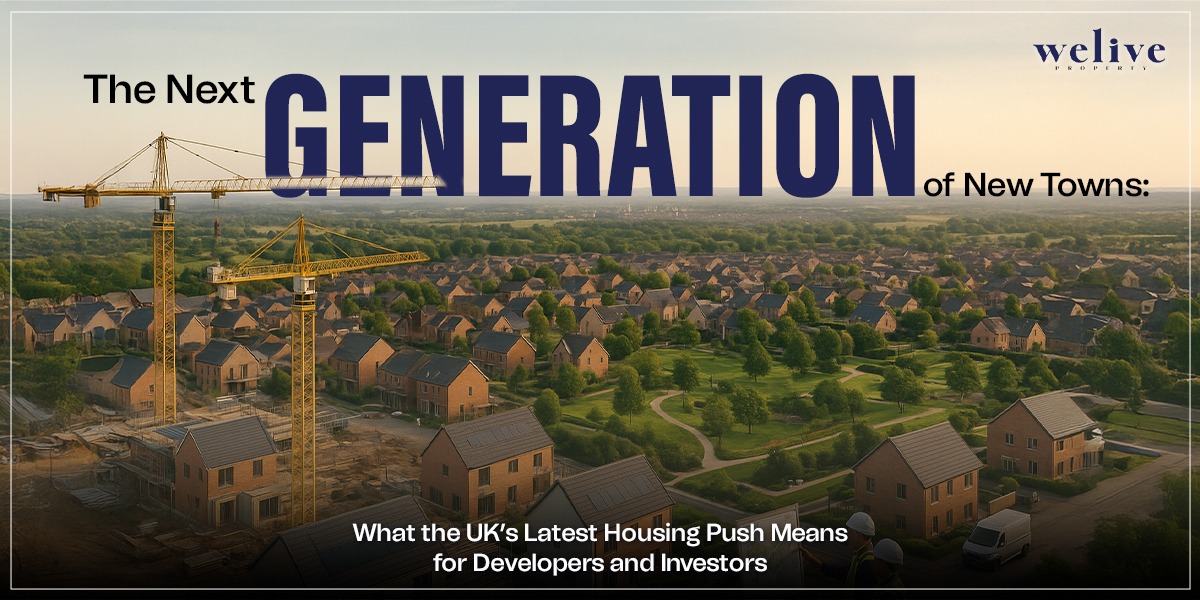
The UK is preparing for one of its most ambitious housing initiatives in decades. On 28 September 2025, the government announced that it will progress work on the next generation of new towns across England, following recommendations made by the New Towns Taskforce, led by Sir Michael Lyons and Dame Kate Barker. The independent report for UK new towns 2025 identifies 12 potential locations where large-scale communities — each with at least 10,000 homes — could be developed to meet England’s growing housing demand and support regional economic growth. Together, these towns could deliver over 300,000 new homes, with a strong focus on affordability, sustainability, and design excellence. For the UK property and development sector, this marks not just a policy update — but a once-in-a-generation opportunity. For companies like WeLive Property, a London-based real estate and planning consultancy specialising in strategic planning, co-living housing, and Build-to-Rent conversions, this national initiative represents more than policy — it’s a blueprint for action. WeLive’s approach bridges government ambition and on-the-ground delivery, helping shape England’s next chapter of housing, regeneration, and community-led growth. With in-house expertise spanning planning applications, ecology reports, construction management, and lifecycle development, WeLive exemplifies the integrated model of progress that the UK new towns 2025 Taskforce envisions. The Vision The UK New Towns 2025 Taskforce, established in July 2024, was created to reimagine how large-scale developments can meet modern housing, infrastructure, and employment needs across the country. Its findings urge the government and developers alike to move beyond incremental reform and embrace transformational housing ecosystems — communities that are affordable, sustainable, and deeply connected. At the heart of this vision lies a dual challenge: addressing the ongoing housing shortage while ensuring that new development respects the environment and enhances liveability. In this context, England’s housing development strategy is increasingly turning toward brownfield regeneration — transforming underused or derelict land into thriving, mixed-use neighbourhoods. According to the National Planning Policy Framework (NPPF), brownfield land refers to “previously developed land” or “land which is, or was, occupied by a permanent structure.” In simple terms, it includes areas that have been built upon in the past but are no longer in active use. These may include: However, not all previously developed land automatically qualifies as brownfield. The NPPF makes key exceptions — such as agricultural buildings, mineral extraction sites, residential gardens, and parks or recreational areas. In some cases, if land has been vacant long enough to return to its natural state, it may no longer meet the definition. While most brownfield sites are found in urban areas, many also exist in rural settings — including within parts of the Green Belt. These spaces offer rare opportunities to unlock new homes, businesses, and community facilities without encroaching on untouched countryside, aligning perfectly with the Taskforce’s emphasis on sustainable growth and spatial balance. One of the most celebrated examples of brownfield transformation is the King’s Cross redevelopment in central London. Once an industrial wasteland, the 67-acre site is now a model of urban regeneration — combining residential, commercial, and cultural spaces in a way that demonstrates how strategic brownfield regeneration can create both economic value and social vibrancy. Building on such precedents, the UK New Towns 2025 initiative proposes that each new settlement include at least 40% affordable housing, with half allocated for social rent. Beyond housing, these developments will feature high-quality transport corridors, advanced environmental standards, and public spaces designed to promote wellbeing and productivity. In shaping these future communities, the Taskforce draws lessons from post-war successes like Milton Keynes — designed not merely as housing, but as a complete ecosystem for living and working. The new towns of today will extend that legacy through transit-oriented development (TOD) — compact, walkable communities built around efficient public transport, cycling, and green infrastructure. This approach directly supports major national growth strategies such as the Oxford–Cambridge Growth Corridor, which exemplifies how coordinated transport and land-use planning can unlock economic potential while reducing car dependency. The goal is clear: to create places that are as connected and inclusive as they are sustainable — a new blueprint for England’s housing development in the 21st century. Transit-Oriented Development UK — Building Smarter, Connected Communities The call for transit-oriented development (TOD) is not new — but it has never been more urgent. The Urban Transport Group’s landmark report, “The Place to Be” (2019), outlined how well-connected, high-density communities can transform the way Britain grows. The report argues that by putting public transport, walking, and cycling at the centre of urban design, cities can expand without fuelling congestion, pollution, or car dependency. According to the report, TODs “put good public transport access at the heart of dense, high-quality residential and commercial developments, with attractive urban realms that support walking and cycling.” This vision aligns directly with the UK New Towns 2025 initiative — ensuring new communities are not just built but are also accessible, inclusive, and sustainable. How WeLive Property Fits Into the Vision of England Housing Development As the UK government prepares to deliver this new wave of towns, WeLive Property stands out as a firm already practicing what policymakers now preach. Based in London, WeLive specialises in managing the entire property development lifecycle — from discovery consultation and planning applications to construction logistics and handover. Our work with London Boroughs, the NHS, and Registered Care Providers highlights how technical precision, regulatory compliance, and design-led planning can come together to create inclusive, future-ready housing. In many ways, WeLive Property’s England housing development projects across Sutton and Croydon serve as microcosms of its next housing chapter. And with the government’s £48 billion commitment to new towns, developers and planners alike will need partners who understand both the policy framework and the practical delivery pipeline. Moreover, for companies like WeLive Property, these principles of Transit-Oriented Development are already part of everyday practice. Projects such as those on Brighton Road, Sutton, show how compact, well-designed developments close to major transport links can maximise land use, reduce reliance on cars, and support … Read more