

When people hear the words “Artificial Intelligence”, their minds leap to self-driving cars or futuristic robots.
But.
In the world of real estate, especially London’s housing market, AI is already at work.
In ways that directly impact how we plan, how we build, and how we live.
At WeLive Property, delivering high-quality Build to Rent Co-Living housing has always been the mission. And as we continue to grow our portfolio across London, we believe the integration of AI in Real Estate will only grow more prominent in the coming years.
From Planning Gridlock to Smarter Approvals
Anyone involved in the planning and development scene within London knows how complex regulations can be. The time taken between submissions and approval can often stretch far longer than it should.
That is why the news of the UK Government introducing Extract is particularly prominent. Jointly developed by the government and Google, Extract promises to alleviate delays by reducing manual checking time, which amounts to an estimated 250,000 hours annually.
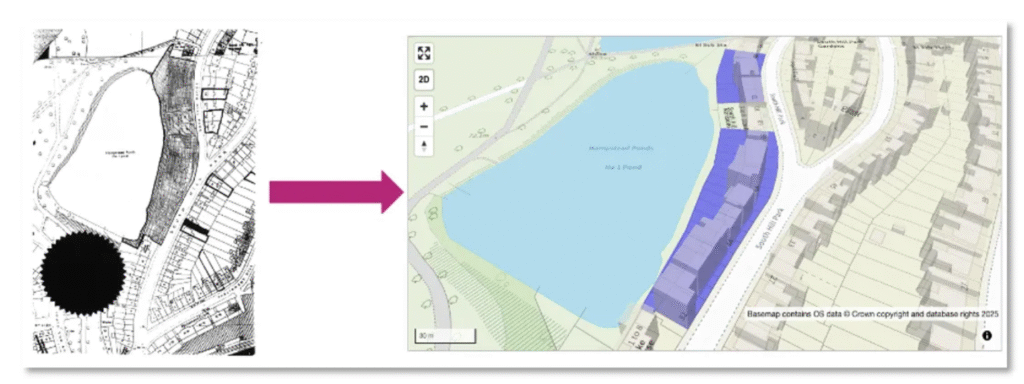
The British government intends to make Extract accessible to all councils by the Spring of 2026. This is believed to align with its broader efforts to digitise the planning system.
One that has long been plagued by productivity.
To this end, a separate report by the Alan Turing Institute, a state-backed research body, found that up to 41 percent of tasks across the public sector could be supported by AI.
The researchers have also piloted their own AI systems, that which can automatically analyze building applications and floor plans. Imagine what this can mean for developers like us.
Fewer Delays. Clearer Decisions. And most importantly: more time focused on delivering homes. Where they are needed the most.
Predictive Maintenance: Fixing Issues Before They Happen
Another area where AI is making waves is in Property Maintenance.
Social Landlords across the UK are already using AI platforms to predict repairs before tenants can even raise their complaints. Moreover, these systems, by analysing patterns in housing data, can further flag issues like boiler faults or leaks in advance.
And the Proof is in the pudding. After using RepairSense, an AI based platform, for a period of 12 months, housing association Karbon Homes had a reduction of repeat repair cases to 3,185.
That is a cost saving of approx. 574,145 GBP.
In another example of integration of AI within real estate, particularly predictive maintenance, GreatWell Homes has significantly improved its operational efficiency, tenant satisfaction and compliance. You can find all the reports on RepairSense’s website.
Speaking about WeLive Property, where we manage all maintenance in-house, such AI-based innovation means be able to provide our tenants with a seamless living experience.
Building Smarter Greener Homes
Where comfort, reliability, and proactive care come first. But, with that in mind, and at a time when the UK is trying to reach net zero by 2050, energy efficiency becomes a vital component as well.
Especially in the design process for new and refurbished buildings.
In the UK, an EPC (energy performance certificate) must be completed everytime a building is sold, rented or constructed. One of the most useful values of this is the asset rating – a number that gives overall energy rating (from A+ to G) and color-coded. However, producing this rating can be a slow process. This is because the calculation requires BER (building emission rate), which can take hours to generate.
Enter Loughborough University, where researchers have designed an AI tool to predict a building energy performance and rating. Done under one second, and using just 27 variables, all with minimal loss in accuracy.
If you find that amazing, wait till you learn about British Land, a company that has piloted digital twins, AKA virtual models of real buildings to simulate energy use, detect inefficiencies and reduce carbon footprint.
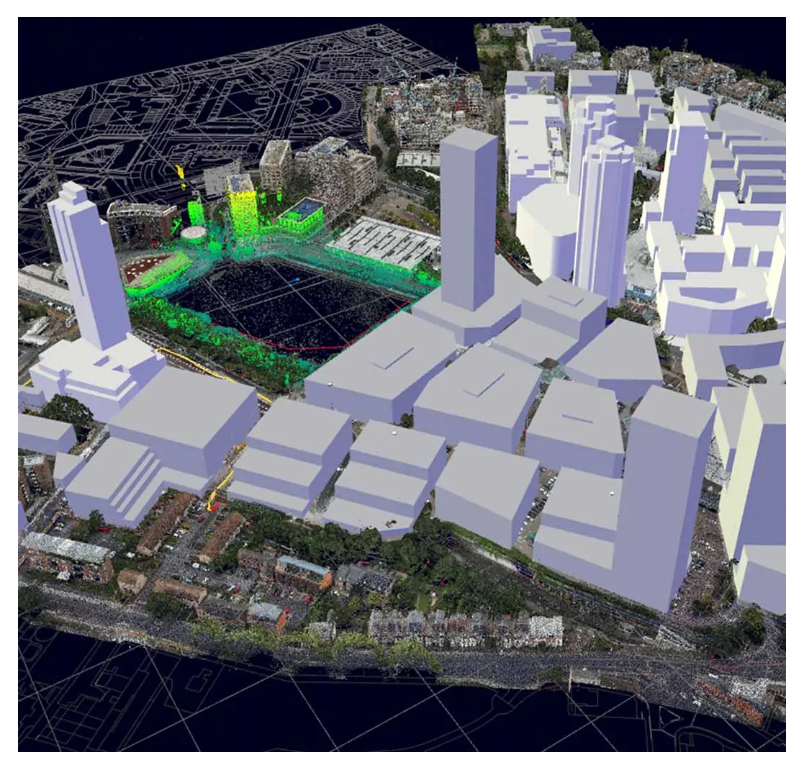
This digital twin provides a complete overview of past and present site data. All in one place. Where multiple teams and project stakeholders can visualize the entire site and its constraints. In doing so, the company has been able to expedite options appraisal process, feasibility report, as well as community impact and risk evaluations.
Talking about our work at WeLive, especially for co-living spaces, where efficiency is multiplied across many rooms and residents, the benefits of such tools are transformative.
Valuation and Investment Decisions
Traditionally, property valuations have been a blend of art and science. But now, implementation of AI in real estate, in the form of Automated Valuation Models (AVMs), is bringing more speed, transparency, and explainability to the process.
But caution must be exercised.
While many envision a fully 100 per cent automated process when it comes to AVMs, the reality is a much broader spectrum….
More in the sense of hybrids involving varying degrees of automation and different levels of human intervention.
Plus, in general terms, AVMs work best with homogenous assets, and their performance degrades with increasingly heterogeneous ones.
Within residential property, where we operate, AVMs cannot be applied where properties do not fulfil the basic criteria of homogeneity. And although work is underway, as per latest RCIS guidelines, to extend the use of residential AVMs, categories such as buy-to-let and houses in multiple occupation are not widely included.
Serving Communities with AI Insights
Perhaps the most exciting potential of AI, in all of this, lies in how it can help housing better community needs.
A recent 2025 UK study with Wolverhampton homes found that AI could predict damp and mold risk with upto 98% accuracy. That is, for well maintained datasets. Then again, even with incomplete data, accuracy remains around 70%.
Another study, this time using 2,073 inspection records across 125 councils confirmed that AI helps to effectively identify homes that are likely to develop damp, enabling more focused maintenance actions.
For us, this only means more good news. We already work closely with all London Boroughs and health stakeholders. Therefore integration of AI into this ecosystem means delivering homes that are not only well-designed and well-managed, but also deeply attuned – to the wellbeing of the people who live in them.
Looking Into The Future
AI is not about replacing human expertise. On the contrary, it is actually all about amplifying it.
At WeLive Property, our strength lies in strategic planning, efficient design and proactive asset management. All combined with a commitment to community needs.
AI gives us the tool to do this even better.
With AI, we are not just adapting to change – we are helping to shape the future of smarter, fairer and better housing in London.
